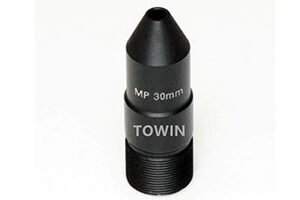


In the world of optics, the achromatic pinhole lens stands out as a revolutionary innovation. Unlike traditional pinhole lenses, which struggle with chromatic aberration—a distortion causing colored fringes around images—the achromatic version corrects this issue by combining materials with different dispersion properties.
How Does an Achromatic Pinhole Lens Work?
A traditional pinhole lens relies on a tiny aperture to project light onto a sensor or film, creating an image without lenses. However, this simplicity comes with drawbacks:
- Chromatic aberration: Different wavelengths of light bend at varying angles, causing blurry edges and color fringing.
- Limited light intake: Small apertures restrict brightness, requiring longer exposure times.
The achromatic pinhole lens addresses these flaws by incorporating materials like flint glass and crown glass. These materials have differing refractive indices, allowing them to bend light in a way that minimizes color separation. The result? A crisper, more vibrant image even in low-light conditions.
5 Key Benefits of the Achromatic Pinhole Lens
1. Eliminates Chromatic Aberration
By balancing light dispersion, the achromatic design ensures all colors focus at the same point, erasing color fringing.
2. Enhanced Image Sharpness
Traditional pinhole lenses produce soft images due to diffraction. The achromatic version reduces this effect, delivering near-lens-quality clarity.
3. Versatility in Lighting
While standard pinhole lenses struggle in dim environments, the achromatic variant captures brighter images with shorter exposure times.
4. Compact and Durable
Like all pinhole systems, it’s lightweight and resistant to shocks, making it ideal for portable devices and harsh industrial settings.
5. Cost-Effective Precision
Achromatic pinhole lenses offer high-end optical performance without the complexity or expense of multi-lens systems.
Applications of the Achromatic Pinhole Lens
The achromatic pinhole lens isn’t just a lab curiosity—it’s transforming industries:
- Photography: Artists and enthusiasts use it for unique soft-focus effects without chromatic noise.
- Microscopy: Biologists rely on it to observe specimens with minimal distortion.
- Industrial Inspection: Manufacturers employ it for quality control, detecting flaws in products with pinpoint accuracy.
- Astrophotography: Astronomers capture clearer images of celestial bodies by reducing color spread.
Common Misconceptions About Achromatic Pinhole Lenses
Myth 1: They’re Only for Low-Resolution Imaging
While pinhole lenses inherently limit resolution, the achromatic design significantly improves sharpness, rivaling basic lenses in many scenarios.
Myth 2: They’re Obsolete in the Digital Age
Digital sensors amplify the benefits of achromatic correction, making these lenses more relevant than ever for high-precision tasks.
Myth 3: They’re Too Complex to Use
Achromatic pinhole lenses operate like standard pinholes but with added color correction. No advanced training is required!
FAQs
1. Are achromatic pinhole lenses expensive?
They’re more affordable than multi-element lenses but slightly pricier than basic pinhole setups due to specialized materials.
2. Do achromatic pinhole lenses work with all camera types?
Yes! They’re compatible with DSLRs, mirrorless cameras, and even smartphones via adapter mounts.
3. How durable are achromatic pinhole lenses?
Extremely durable. Without moving parts, they resist scratches, dust, and impacts better than most lenses.
4. Can I build an achromatic pinhole lens at home?
While possible, achieving precise color correction requires specialized materials and machining. Pre-made options are recommended for most users.
5. What’s the future of achromatic pinhole technology?
Advances in nanotechnology could lead to even smaller, more efficient designs, expanding their use in medical imaging and augmented reality.
Why Choose an Achromatic Pinhole Lens?
If you value precision, affordability, and simplicity, the achromatic pinhole lens is a must-try. Whether you’re a hobbyist exploring creative photography or a professional needing reliable industrial optics, this innovation bridges the gap between traditional pinhole limitations and modern demands.
By eliminating chromatic aberration and enhancing image quality, the achromatic pinhole lens proves that sometimes, the simplest solutions are the most revolutionary.
Final Thoughts
The achromatic pinhole lens isn’t just a niche tool—it’s a testament to how targeted optical engineering can solve age-old problems. As industries continue to demand higher accuracy at lower costs, expect this technology to shine brighter than ever.