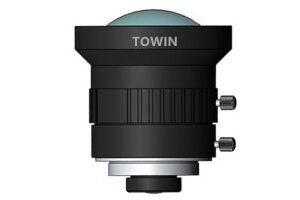


Machine vision lens are the cornerstone of modern industrial automation, enabling robots, inspection systems, and AI-driven processes to “see” with precision. However, distortion—a deviation from ideal geometric imaging—can compromise accuracy, leading to costly errors in applications like quality control, robotic guidance, and 3D reconstruction.
What Is Distortion in Machine Vision Lenses?
Distortion occurs when light rays passing through a lens do not converge perfectly, causing straight lines in the real world to appear curved or stretched in images. Unlike blur or chromatic aberration, distortion alters the shape of objects without affecting sharpness.
In machine vision, even minor distortion can disrupt measurements, barcode scanning, or object recognition. For instance, a distorted image of a circuit board might mislead a robotic arm during assembly, resulting in defective products.
Types of Distortion in Machine Vision Lenses
1. Barrel Distortion:
Lines curve inward, resembling a barrel. Common in wide-angle lenses, it’s problematic for applications requiring straight-line accuracy, like architectural scanning or flat-surface inspection.
2. Pincushion Distortion:
Lines curve outward, forming a pincushion shape. This occurs in telecentric or long-focal-length lenses and affects tasks like metrology or precision alignment.
3. Mustache Distortion:
A complex mix of barrel and pincushion distortion, often seen in zoom lenses. It’s harder to correct and requires advanced calibration.
5 Critical Impacts of Distortion on Machine Vision Systems
1. Measurement Errors
Machine vision systems often rely on pixel-to-millimeter conversions for dimensional analysis. Distortion skews these calculations, leading to incorrect part sizes or misaligned components. For example, a 0.1% distortion in a lens inspecting a 100mm part could cause a 0.1mm error—critical in aerospace or medical device manufacturing.
2. Reduced Accuracy in Object Recognition
Algorithms like edge detection or pattern matching depend on straight lines and consistent shapes. Distortion warps these features, causing false positives or negatives. A robotic sorter might misclassify products, increasing waste and downtime.
3. Compromised 3D Reconstruction
Stereo vision systems use two lenses to create depth maps. Distortion mismatches between lenses distort 3D models, affecting robotic grasping or autonomous vehicle navigation.
4. Barcode and Text Reading Failures
Distorted barcodes or text appear illegible to scanners, halting production lines. This is common in logistics or pharmaceutical packaging, where speed and accuracy are non-negotiable.
5. Increased Calibration Complexity
Correcting distortion requires intricate calibration using tools like checkerboard patterns or laser interferometers. This adds time and cost to system setup, especially for multi-lens configurations.
How to Measure and Correct Distortion in Machine Vision Lenses
Measurement Techniques
- Test Targets: Use grids or dot patterns to identify curvature in lines. Software like MATLAB or OpenCV analyzes deviations from ideal geometry.
- Modulation Transfer Function (MTF): While primarily for sharpness, MTF charts can reveal distortion at specific frequencies.
- Lens Datasheets: Reputable manufacturers (e.g., Edmund Optics) provide distortion profiles, aiding pre-purchase selection.
Correction Methods
- Optical Design: Aspheric lenses or telecentric optics minimize distortion by design.
- Software Compensation: Algorithms undistort images using calibration maps. For example, OpenCV’s undistort() function applies precomputed distortion coefficients.
- Hybrid Approaches: Combining optical improvements with software tweaks offers the best balance of cost and performance.
FAQs
Can distortion be completely eliminated?
No, but it can be reduced to negligible levels. Telecentric lenses, for instance, achieve distortion below 0.01%, suitable for high-precision tasks.
Does higher resolution reduce distortion?
Resolution and distortion are independent. A 10MP lens can have worse distortion than a 2MP lens if poorly designed. Always prioritize distortion specs over megapixels.
Are there industry standards for acceptable distortion levels?
Yes, standards like ISO 17424-6 guide distortion measurement in industrial lenses. Many sectors, like automotive or semiconductor, enforce stricter internal limits.
Can cheap lenses perform well in distortion-sensitive applications?
Generally, no. Low-cost lenses often compromise on optical quality to cut costs. Invest in reputable brands for critical systems.
Conclusion
How does distortion affect machine vision lenses? The answer lies in its far-reaching consequences—from measurement inaccuracies to production delays. By understanding distortion types, measuring them rigorously, and applying optical or software corrections, engineers can ensure their systems deliver the precision demanded by Industry 4.0.